
Nissan Versa (N17): Compressor
Exploded View
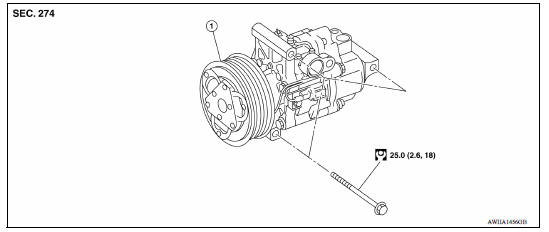
1. Compressor
Removal and Installation
CAUTION: Perform oil return operation before each refrigeration system disassembly. However, if a large amount of refrigerant or oil is detected, do not perform oil return operation. Refer to HA "Perform Oil Return Operation".
REMOVAL
- Use refrigerant collecting equipment (for HFC-134a) to discharge the refrigerant. Refer to HA "Recycle Refrigerant".
- Remove the high and low-pressure flexible hose bolts and disconnect low-pressure flexible hose and high-pressure flexible hose from the compressor. CAUTION: Cap or wrap the joint of the A/C piping and compressor with suitable material such as vinyl tape to avoid the entry of air.
- Remove the engine under cover. Refer to EXT "Removal and Installation".
- Remove drive belt. Refer to EM "Removal and Installation".
- Disconnect the harness connector from the compressor (magnet clutch).
- Remove compressor bolts and the compressor.
INSTALLATION
Installation is in the reverse order of removal.
CAUTION:
- Do not reuse O-rings.
- Apply A/C oil to the O-rings of the low-pressure flexible hose and high-pressure flexible hose for installation.
- Perform oil adjusting procedure before installing new compressor. Refer to HA "Oil Adjusting Procedure for Components Replacement Except Compressor".
- After charging the A/C refrigerant, check for leaks. Refer to HA "Leak Test".
- Check tension of the drive belt after installing compressor. Refer to EM "Inspection".
Inspection
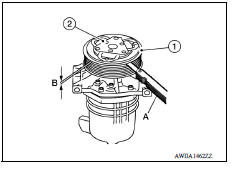
CHECK DISC TO PULLEY CLEARANCE
Check the clearance (B) between pulley assembly (1) and clutch disc (2) along the entire periphery with a feeler gauge (A).
Clearance : Refer to HA "Compressor".
If specified clearance is not obtained, replace adjusting spacer and readjust.
 Performance test
Inspection INSPECTION PROCEDURE Connect recovery/recycling/recharging equipment (for HFC-134a) or manifold gauge. Start the engine, and set to the following condition. Test condition&nbs ...
Condenser
Exploded View 1. Condenser 2. O-rings 3. Liquid tank bracket 4. Liquid tank 5. O-ring 6. Refrigerant pressure sensor Removal and Installation CAUTION: Perform oil return operation before each ...
Other materials:
Starting the engine (models with NISSAN Intelligent Key system)
1. Apply the parking brake.
2. Move the shift lever to P (Park) or N (Neutral).
P (Park) is recommended.
The starter is designed not to operate if
the shift lever is in any of the driving
positions.
3. Push the ignition switch to the ON position.
Depress the brake pedal and push the ...
Continuously Variable Transmission (CVT) fluid (if so equipped)
CAUTION
NISSAN recommends using Genuine
NISSAN CVT Fluid NS-3 (or equivalent)
ONLY in NISSAN CVTs. Do not mix with
other fluids.
Do not use Automatic transmission
fluid (ATF) or Manual transmission fluid
in a NISSAN CVT, as it may damage the
CVT. Damage caused by the use of fluids
...
Categories
- Manuals Home
- Nissan Versa Owners Manual
- Nissan Versa Service Manual
- Video Guides
- Questions & Answers
- External Resources
- Latest Updates
- Most Popular
- Sitemap
- Search the site
- Privacy Policy
- Contact Us

0.0115