
Nissan Versa (N17): Intake valve timing control
Intake valve timing control : System Diagram
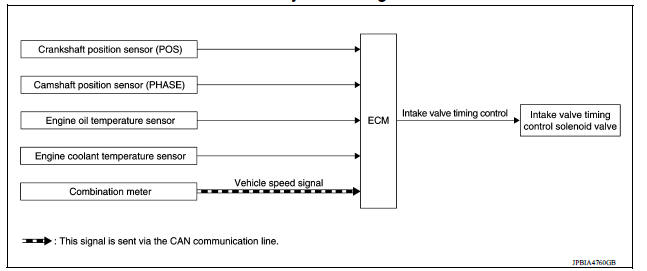
Intake valve timing control : system description
INPUT/OUTPUT SIGNAL CHART
| Sensor | Input signal to ECM | ECM function | Actuator |
| Crankshaft position sensor (POS) | Engine speed*1 Piston position | Intake valve timing control | Intake valve timing control solenoid valve |
| Camshaft position sensor (PHASE) | |||
| Engine oil temperature sensor | Engine oil temperature | ||
| Engine coolant temperature sensor | Engine coolant temperature | ||
| Combination meter | Vehicle speed*2 |
*1: ECM determines the start signal status by the signals of engine speed and battery voltage.
*2: This signal is sent to the ECM through CAN communication line.
SYSTEM DESCRIPTION
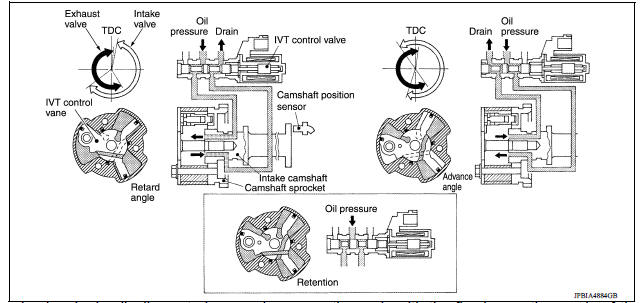
This mechanism hydraulically controls cam phases continuously with the fixed operating angle of the intake valve.
The ECM receives signals such as crankshaft position, camshaft position, engine speed, engine oil temperature and engine coolant temperature. Then, the ECM sends ON/OFF pulse duty signals to the intake valve timing (IVT) control solenoid valve depending on driving status. This makes it possible to control the shut/open timing of the intake valve to increase engine torque in low/mid speed range and output in highspeed range.
 Evaporative emission system
EVAPORATIVE EMISSION SYSTEM : System Diagram EVAPORATIVE EMISSION SYSTEM : System Description INPUT/OUTPUT SIGNAL CHART Sensor Input signal to ECM ECM function Actuator ...
Exhaust valve timing control
Exhaust valve timing control : system diagram Exhaust valve timing control : system description INPUT/OUTPUT SIGNAL CHART Sensor Input signal to ECM ECM function Actuator ...
Other materials:
U1117 Lost communication (ABS)
DTC Logic
DTC DETECTION LOGIC
DTC
Trouble diagnosis name
DTC detection condition
Possible causes
U1117
Lost Communication With ABS
When the ignition switch is ON,
TCM is unable to receive the
CAN communications signal
from ABS actuator control unit
cont ...
Line pressure test
Work Procedure
INSPECTION
Check the engine oil level. Replenish if necessary. Refer to LU
"Inspection".
Check for CVT fluid leaks. Refer to TM "Inspection".
Drive for about 10 minutes to warm up the vehicle so that the CVT fluid
temperature is 50 to 80C (122 to
...
Categories
- Manuals Home
- Nissan Versa Owners Manual
- Nissan Versa Service Manual
- Video Guides
- Questions & Answers
- External Resources
- Latest Updates
- Most Popular
- Sitemap
- Search the site
- Privacy Policy
- Contact Us

0.0103