
Nissan Versa (N17): P0998 Shift solenoid F
DTC Logic
DTC DETECTION LOGIC
| DTC | Trouble diagnosis name | DTC detection condition | Possible causes |
| P0998 | Shift solenoid F control circuit low | The TCM low brake solenoid valve current
monitor reading is 200 mA or less continuously
for 480 msec or more under the following diagnosis
conditions: - Diagnosis conditions - Solenoid valve output current: 750 mA or more - GND short circuit diagnosis occurs in the solenoid valve drive circuit. - TCM power supply voltage: More than 11 V |
- Harness or connector
(Low brake solenoid valve circuit shorted
to ground) - Low brake solenoid valve |
DTC CONFIRMATION PROCEDURE
1.PREPARATION BEFORE WORK
If another "DTC CONFIRMATION PROCEDURE" occurs just before, turn ignition switch OFF and wait for at least 10 seconds, then perform the next test.
>> GO TO 2.
2.CHECK DTC DETECTION
- Start the engine.
- Shift the selector lever to "D" position and wait for 5 seconds or more.
- Check the first trip DTC.
Is "P0998" detected?
YES >> Go to TM "Diagnosis Procedure".
NO >> INSPECTION END
Diagnosis Procedure
1.CHECK CIRCUIT BETWEEN TCM AND CVT UNIT
- Turn ignition switch OFF.
- Disconnect TCM connector and CVT unit connector.
- Check continuity between TCM harness connector terminal and ground.
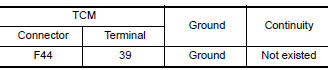
Is the inspection result normal?
YES >> GO TO 2.
NO >> Repair or replace malfunctioning parts.
2.CHECK LOW BRAKE SOLENOID VALVE
Check low brake solenoid valve. Refer to TM "Component Inspection (Low Brake Solenoid Valve)".
Is the inspection result normal?
YES >> Check intermittent incident. Refer to GI "Intermittent Incident".
NO >> Repair or replace malfunctioning parts.
Component Inspection (Low Brake Solenoid Valve)
1.CHECK LOW BRAKE SOLENOID VALVE
Check resistance between CVT unit connector terminal and ground. 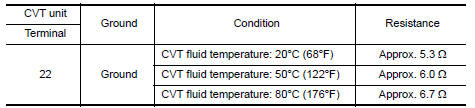
Is the inspection result normal?
YES >> INSPECTION END
NO >> There is a malfunction of low brake solenoid valve. Replace transaxle assembly. Refer to TM "Removal and Installation".
 P0967 Pressure control solenoid B
Other materials:
Camshaft
Exploded View
1. Camshaft bracket (No. 2 to 5) 2. Camshaft bracket (No. 1) 3. Camshaft
sprocket (EXH)
4. Exhaust valve timing control solenoid
valve 5. Oring 6. Camshaft sprocket (INT)
7. Plug (EXH) 8. Washer (EXH) 9. Oil filter (for exhaust valve timing control
solenoid valve)
10. Cylinde ...
C1145, C1146 Yaw rate/side/decel g
sensor
DTC Logic
DTC DETECTION LOGIC
DTC CONFIRMATION PROCEDURE
1.CHECK SELF DIAGNOSTIC RESULT
With CONSULT.
Turn ignition switch OFF to ON.
Perform self diagnostic result.
Is DTC C1145 or C1146 detected?
YES >> Proceed to diagnosis procedure. Refer to BRC "Diagn ...
Categories
- Manuals Home
- Nissan Versa Owners Manual
- Nissan Versa Service Manual
- Video Guides
- Questions & Answers
- External Resources
- Latest Updates
- Most Popular
- Sitemap
- Search the site
- Privacy Policy
- Contact Us

0.0104