
Nissan Versa (N17): Component parts
Component Parts Location
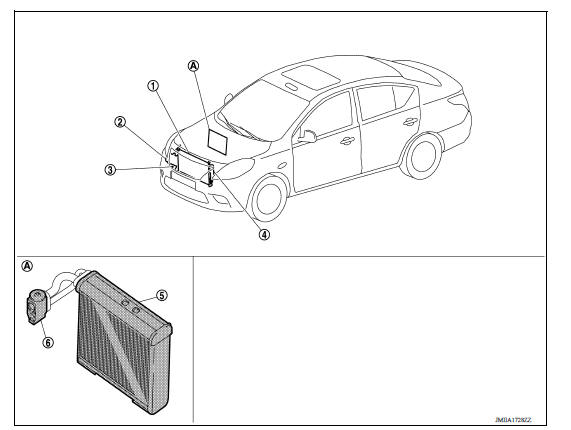
1. Condenser 2. Compressor 3. Refrigerant pressure sensor 4. Liquid tank 5. Evaporator 6. Expansion valve A. Built-in heater & cooling unit assembly
Component Description
| Component | Description |
| Evaporator | The mist form liquid refrigerant transforms to gas by evaporation by the air conveyed from blower motor. The air is cooled by the heat by evaporation. |
| Condenser | Cools refrigerant discharged from compressor, and transforms it to liquid refrigerant. |
| Compressor | Intakes, compresses, and discharges refrigerant, to circulate refrigerant inside the refrigerant cycle. |
| Refrigerant pressure sensor | Refer to HA "Removal and Installation". |
| Liquid tank | Eliminates foreign matter in refrigerant, and temporarily stores liquid refrigerant. |
| Expansion valve | Transforms high-pressure liquid refrigerant to mist form low-pressure liquid refrigerant by drawing function. |
 Preparation
Special Service Tool The actual shape of Kent-Moore tools may differ from those of special service tools illustrated here. HFC-134a (R-134a) Service Tool and Equipment Do not mix HFC-134a (R- ...
Refrigeration system
Refrigerant Cycle REFRIGERANT FLOW The refrigerant flows in the standard pattern, that is, through the compressor, the condenser with liquid tank, through the evaporator, and back to the compress ...
Other materials:
Owner's Manual/Service Manual order information
Genuine NISSAN Service Manuals for this model
year and prior can be purchased. A Genuine
NISSAN Service Manual is the best source of
service and repair information for your vehicle.
This manual is the same one used by the factorytrained
technicians working at NISSAN dealerships.
Genuine NI ...
Center console assembly
Exploded View
1. M/T console boot (M/T models) 2. Center console assembly
Removal and Installation
REMOVAL
Move shift selector to "N" position (CVT models or A/T models).
Remove shift selector handle and console boot (M/T models).
Raise parking brake lever.
Remove center console ...
Categories
- Manuals Home
- Nissan Versa Owners Manual
- Nissan Versa Service Manual
- Video Guides
- Questions & Answers
- External Resources
- Latest Updates
- Most Popular
- Sitemap
- Search the site
- Privacy Policy
- Contact Us

0.0129