
Nissan Versa (N17): Coil spring
Exploded View
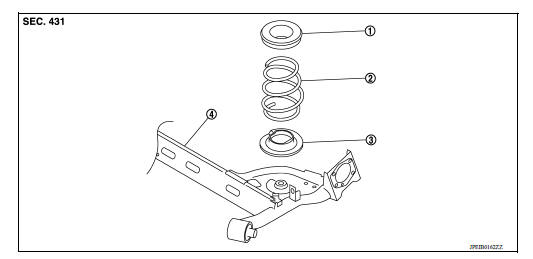
1. Upper rubber seat 2. Coil spring 3. Lower rubber seat 4. Rear suspension beam
Removal and Installation
REMOVAL
- Remove the wheel and tire assemblies using power tool. Refer to WT "Adjustment".
- Position a suitable jack under rear suspension beam.
CAUTION:
- Place the jack in the center of the suspension beam.
- Do not damage the suspension beam with jack.
- Remove the lower shock absorber bolts. Refer to RSU "Removal and Installation".
- Slowly lower jack, then remove upper rubber seat, coil spring and lower rubber seat from rear suspension beam.
INSTALLATION
Installation is in the reverse order of removal.
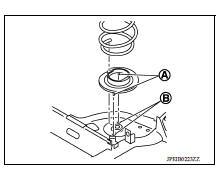
- Install the lower rubber seat (A) to the rear suspension beam mounting hole (B).
- Match up lower rubber seat indentions and rear suspension beam grooves and attach.
Inspection
INSPECTION AFTER REMOVAL
Check rubber seat and coil spring for deformation, crack, and damage. Replace it if necessary.
INSPECTION AFTER INSTALLATION
Check wheel alignment. Refer to RSU "Inspection".
 Rear shock absorber
Exploded View 1. Piston rod lock nut 2. Washer 3. Bushing 4. Distance tube 5. Bound bumper cover 6. Bound bumper 7. Shock absorber assembly 8. Rear suspension beam ...
Rear suspension beam
Exploded View 1. Rear suspension beam Removal and Installation REMOVAL Remove the wheel and tire assemblies using power tool. Refer to WT "Adjustment". Remove wheel sensor ...
Other materials:
Steering wheel
Tilt operation
Push the lock lever 1 down and adjust the
steering wheel up or down 2 to the desired
position.
Pull the lock lever 1 up to lock the steering
wheel in place.
WARNING
Do not adjust the steering wheel while
driving. You could lose control of your
vehicle and cause an accid ...
Continuously Variable Transmission (CVT) fluid (if so equipped)
CAUTION
NISSAN recommends using Genuine
NISSAN CVT Fluid NS-3 (or equivalent)
ONLY in NISSAN CVTs. Do not mix with
other fluids.
Do not use Automatic transmission
fluid (ATF) or Manual transmission fluid
in a NISSAN CVT, as it may damage the
CVT. Damage caused by the use of fluids
...
Categories
- Manuals Home
- Nissan Versa Owners Manual
- Nissan Versa Service Manual
- Video Guides
- Questions & Answers
- External Resources
- Latest Updates
- Most Popular
- Sitemap
- Search the site
- Privacy Policy
- Contact Us

0.0113