
Nissan Versa (N17): Fuel filler opener cable
FUEL FILLER OPENER CABLE : Removal and Installation
REMOVAL
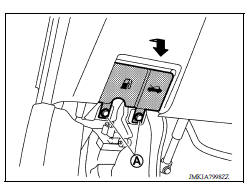
1. Remove hood and fuel filler handle assembly bolts (A).
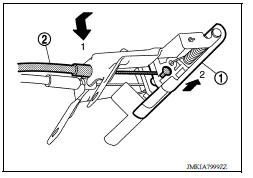
2. Disconnect fuel filler lid opener cable (2) by pulling downward and then sliding cable end to the side to remove from hood and fuel filler handle assembly (1).
3. Remove dash side finisher (LH). Refer to INT "DASH SIDE FINISHER : Removal and Installation".
4. Remove center pillar lower finisher (LH). Refer to INT "CENTER PILLAR LOWER FINISHER : Removal and Installation".
5. Remove trunk side finisher (LH). Refer to INT"TRUNK SIDE FINISHER : Removal and Installation".
6. Remove fuel filler lid opener cable from fuel filler lid lock assembly. Refer to DLK "FUEL FILLER LID LOCK : Removal and Installation".
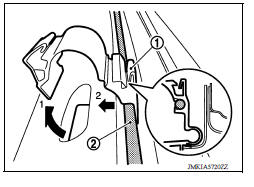
7. Disengage each harness protector (1), and then remove fuel filler lid opener cable (2).
INSTALLATION
Installation is in the reverse order of removal.
CAUTION: After installation, check fuel filler lid assembly open/close, lock/unlock operation.
NOTE:
- The following table shows the specifications for a correctly installed fuel filler lid.
- Fitting adjustment cannot be performed.

 Fuel filler lid
FUEL FILLER LID : Removal and Installation REMOVAL 1. Fully open fuel filler lid. 2. Remove fuel cap pin (1). 3. Remove fuel filler lid screws and fuel filler lid. INSTALLATION Installation is ...
Fuel filler lid lock
FUEL FILLER LID LOCK : Removal and Installation REMOVAL 1. Fully open fuel filler lid. 2. Remove trunk side finisher (LH). Refer to INT "TRUNK SIDE FINISHER : Removal and Installation". ...
Other materials:
Vehicle loading information
WARNING
It is extremely dangerous to ride
in a cargo area inside a vehicle. In
a collision, people riding in these
areas are more likely to be seriously
injured or killed.
Do not allow people to ride in any
area of your vehicle that is not
equipped with seats and seat
belts.
Be ...
Differential side oil seal
Exploded View
1. Transaxle assembly 2. Differential side oil seal (left side) 3.
Differential side oil seal (right side)
Front Genuine
NISSAN CVT Fluid NS-3
Removal and Installation
NOTE:
When removing components such as hoses, tubes/lines, etc., cap or plug openings
to prevent flui ...
Categories
- Manuals Home
- Nissan Versa Owners Manual
- Nissan Versa Service Manual
- Video Guides
- Questions & Answers
- External Resources
- Latest Updates
- Most Popular
- Sitemap
- Search the site
- Privacy Policy
- Contact Us

0.0114